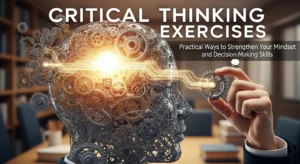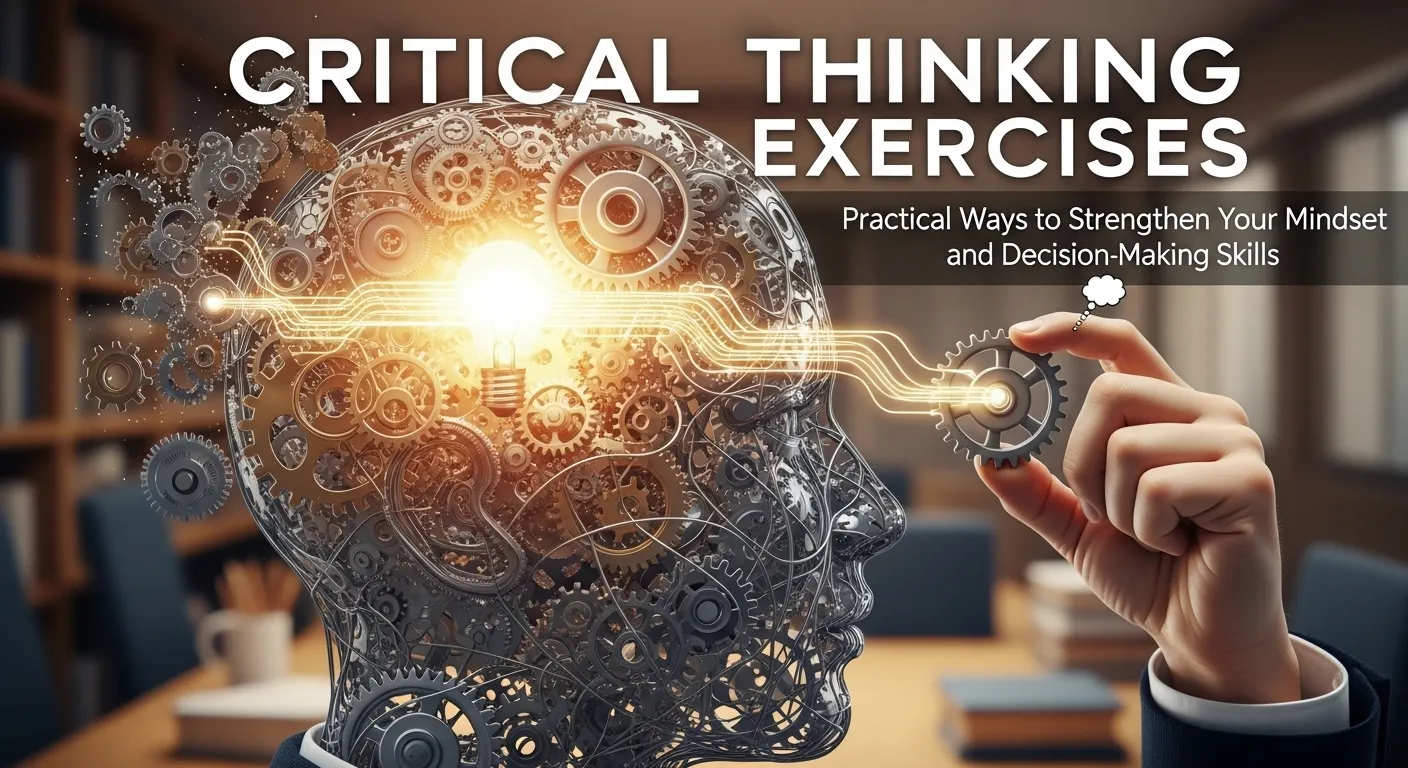
Critical thinking exercises are structured mental activities designed to improve how you analyze information, evaluate evidence, and make reasoned decisions. In a world filled with constant information, opinions, and distractions, strong critical thinking skills are no longer optional—they are essential for academic success, professional growth, and everyday problem-solving.
This article explores what critical thinking exercises are, why they matter, and how to use them effectively. You’ll also learn practical exercises that develop logic, reasoning, reflection, and analytical thinking without relying on memorization or surface-level understanding.
What Are Critical Thinking Exercises?
Critical thinking exercises are intentional activities that challenge the brain to question assumptions, identify patterns, analyze arguments, and reach well-supported conclusions. Unlike passive learning, these exercises actively engage cognitive skills such as reasoning, inference, interpretation, and evaluation.
They are commonly used in education, workplace training, leadership development, and personal growth because they strengthen mental clarity and independent thinking.
Why Critical Thinking Exercises Matter
Critical thinking is the foundation of sound judgment. Exercises that train this skill help individuals move beyond emotional reactions and automatic responses.
Key benefits include:
- Improved problem-solving ability
- Stronger decision-making skills
- Better evaluation of information and sources
- Enhanced creativity and adaptability
- Reduced cognitive bias
People who regularly practice critical thinking exercises are more confident in their conclusions and more open to alternative perspectives.
Core Skills Developed Through Critical Thinking Exercises
Critical thinking exercises target multiple mental skills at once. These include logical reasoning, analytical thinking, reflective thinking, and metacognition.
Logical reasoning helps identify valid and invalid arguments. Analytical thinking allows complex ideas to be broken into manageable parts. Reflective thinking encourages reviewing one’s own thought process, while metacognition builds awareness of how decisions are formed.
Together, these skills create a disciplined and flexible mindset.
Analytical Critical Thinking Exercises
Analytical exercises focus on breaking down information and identifying relationships between ideas. They are especially useful in academic and professional environments.
One effective method is argument analysis. This involves identifying a claim, examining supporting evidence, and evaluating whether the conclusion logically follows. Another powerful exercise is comparison analysis, where two ideas, solutions, or viewpoints are examined side by side to determine strengths, weaknesses, and implications.
These exercises sharpen attention to detail and reduce superficial thinking.
Problem-Solving Critical Thinking Exercises
Problem-solving exercises challenge individuals to move from confusion to clarity through structured reasoning. These exercises often involve real-world scenarios rather than theoretical questions.
A common approach is scenario-based problem solving. You are presented with a situation, limited information, and multiple possible actions. The goal is to evaluate consequences, prioritize evidence, and select the most reasonable solution.
Another effective technique is root cause analysis, which focuses on identifying the underlying cause of a problem rather than addressing symptoms.
Reflective Thinking Exercises
Reflective thinking exercises encourage self-examination and deeper understanding. They help identify mental habits, assumptions, and biases that influence judgment.
One example is reflective journaling, where you write about a decision you made and analyze why you made it, what information you used, and how emotions influenced the outcome. Another approach is post-decision reflection, which involves reviewing results and assessing what could be improved.
These exercises strengthen self-awareness and long-term learning.
Critical Reading and Evaluation Exercises
Critical thinking exercises are especially important when consuming written content such as articles, reports, or research. Critical reading involves questioning the author’s intent, credibility, and logic.
An effective exercise is claim verification. You identify key claims in a text and check whether they are supported by evidence or rely on assumptions. Bias detection exercises help uncover emotional language, selective data use, or misleading framing.
These practices are essential in the digital age, where misinformation is widespread.
Creative Critical Thinking Exercises
Critical thinking is not limited to logic alone—it also supports creativity. Creative critical thinking exercises encourage generating multiple solutions and exploring unconventional perspectives.
Brainstorming with constraints is a powerful technique. Instead of unlimited ideas, you work within specific limits, forcing deeper reasoning. Perspective-shifting exercises ask you to analyze a problem from different roles or viewpoints, expanding cognitive flexibility.
These exercises improve innovation while maintaining structured thinking.
Group-Based Critical Thinking Exercises
Collaborative exercises develop communication and reasoning skills simultaneously. Group discussions, debates, and case studies expose participants to diverse viewpoints and challenge confirmation bias.
Structured debates are particularly effective. Participants must defend a position using evidence and logic, even if they personally disagree with it. This strengthens intellectual humility and argument evaluation skills.
Group-based exercises are widely used in classrooms, leadership training, and team development programs.
Daily Critical Thinking Exercises for Real Life
Critical thinking exercises don’t have to be formal or time-consuming. Everyday situations provide constant opportunities to practice.
Questioning assumptions in news stories, evaluating product reviews before purchasing, and analyzing personal decisions are all forms of applied critical thinking. Asking simple questions such as “What evidence supports this?” or “What alternative explanations exist?” builds mental discipline over time.
Consistency matters more than complexity.
How to Practice Critical Thinking Exercises Effectively
To get the most benefit, exercises should be practiced intentionally and regularly. Start with simple tasks and gradually increase complexity. Focus on quality rather than quantity.
It’s important to remain open-minded and willing to revise conclusions when new evidence appears. Critical thinking is not about being right—it’s about being reasonable.
Tracking progress through reflection or feedback further enhances skill development.
Common Mistakes When Practicing Critical Thinking
Many people confuse critical thinking with criticism. True critical thinking is constructive, not dismissive. Another common mistake is overconfidence—assuming logic is being used without actually examining evidence.
Avoid rushing to conclusions and relying solely on intuition. Effective exercises slow down thinking and encourage deliberate analysis.
Conclusion
Critical thinking exercises are powerful tools for developing clarity, confidence, and intellectual independence. By strengthening reasoning, analysis, reflection, and problem-solving skills, these exercises prepare individuals to navigate complex information and make better decisions.
Whether used in education, professional settings, or personal life, consistent practice of critical thinking exercises leads to sharper judgment and a more thoughtful approach to the world. In an age where information is abundant but understanding is rare, critical thinking remains one of the most valuable skills you can develop.

𝑯𝒊, 𝑰’𝒎 Emma 𝒕𝒉𝒆 𝒄𝒓𝒆𝒂𝒕𝒐𝒓 𝒐𝒇 𝑴𝒆𝒆𝒂𝒏𝒊𝒏𝒈.𝒄𝒐𝒎, 𝒂 𝒔𝒊𝒕𝒆 𝒅𝒆𝒅𝒊𝒄𝒂𝒕𝒆𝒅 𝒕𝒐 𝒆𝒙𝒑𝒍𝒐𝒓𝒊𝒏𝒈 𝒕𝒉𝒆 𝒕𝒓𝒖𝒆 𝒎𝒆𝒂𝒏𝒊𝒏𝒈𝒔 𝒃𝒆𝒉𝒊𝒏𝒅 𝒘𝒐𝒓𝒅𝒔 𝒂𝒏𝒅 𝒑𝒉𝒓𝒂𝒔𝒆𝒔.
𝑴𝒚 𝒈𝒐𝒂𝒍 𝒊𝒔 𝒕𝒐 𝒉𝒆𝒍𝒑 𝒚𝒐𝒖 𝒖𝒏𝒅𝒆𝒓𝒔𝒕𝒂𝒏𝒅 𝒆𝒗𝒆𝒓𝒚 𝒘𝒐𝒓𝒅 𝒅𝒆𝒆𝒑𝒍𝒚 𝒂𝒏𝒅 𝒄𝒍𝒆𝒂𝒓𝒍𝒚, 𝒔𝒐 𝒚𝒐𝒖𝒓 𝒔𝒆𝒂𝒓𝒄𝒉 𝒇𝒐𝒓 𝒎𝒆𝒂𝒏𝒊𝒏𝒈𝒔 𝒇𝒊𝒏𝒂𝒍𝒍𝒚 𝒆𝒏𝒅𝒔 𝒉𝒆𝒓𝒆!