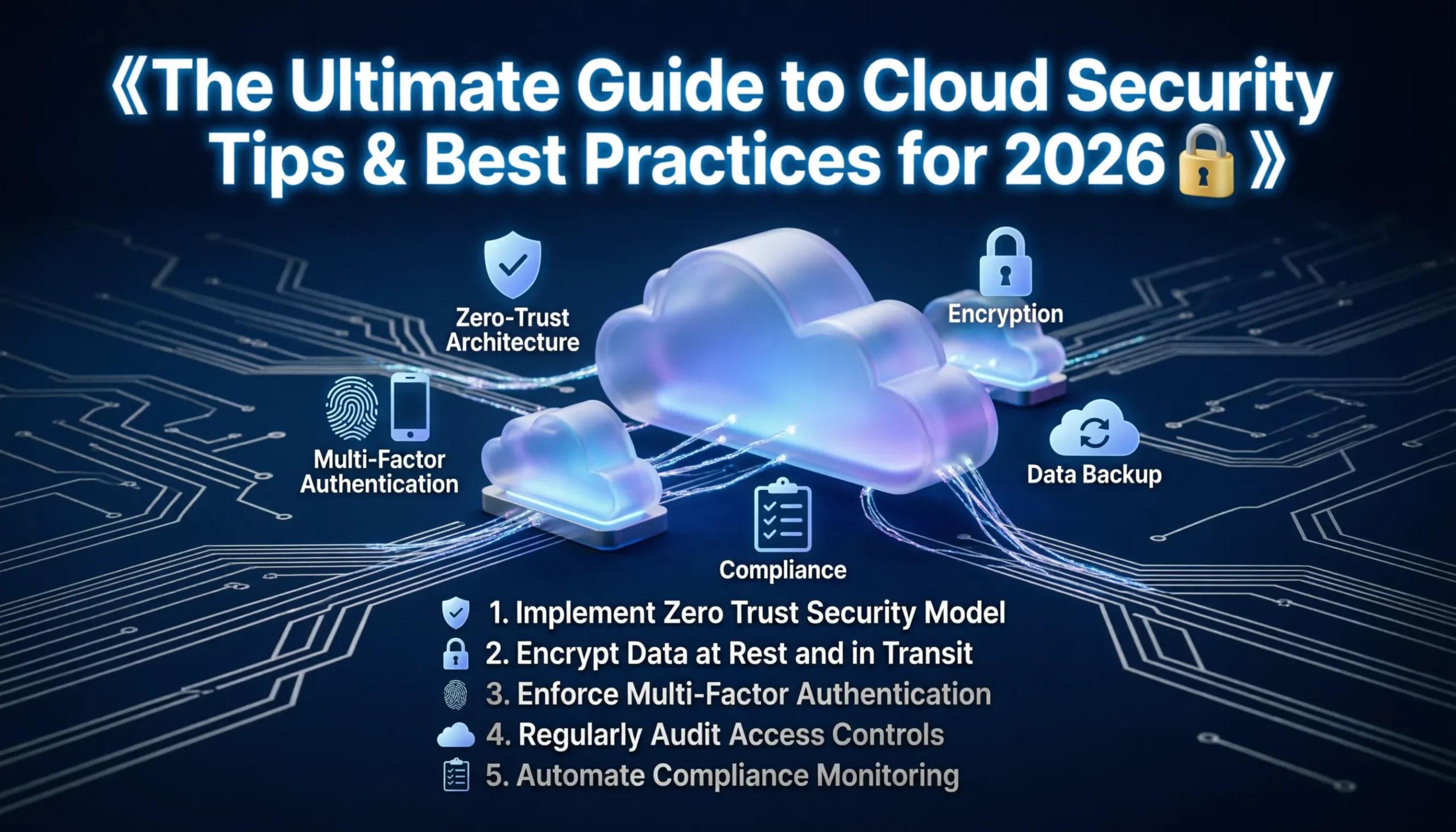
In today’s digital world, cloud computing is no longer optional it is essential. From startups to Fortune 500 companies, organizations rely on the cloud for storage, applications, collaboration, analytics, and AI-driven innovation.
But as cloud adoption grows, so do cyber threats.
Data breaches, ransomware attacks, insider threats, and misconfigured storage buckets have cost businesses billions of dollars globally. According to the 2025 IBM Cost of a Data Breach Report, the average global data breach cost reached $4.45 million with cloud misconfigurations being one of the top causes.
That’s why understanding Cloud security tips, Cloud security best practices, and strong Cloud security strategies is no longer optional it’s critical.
This comprehensive guide will walk you through:
- Proven Cloud data protection techniques
- Modern Secure cloud computing frameworks
- Advanced Cloud threat protection methods
- Compliance, encryption, access control, and more
Let’s dive deep into securing your cloud environment in 2026.
What Is Cloud Security?
Cloud security refers to the technologies, policies, controls, and services that protect cloud-based systems, data, and infrastructure.
Cloud security combines:
- 🔐 Cybersecurity
- 🛡️ Data protection
- 🌐 Network security
- 👤 Identity and access management
- ⚙️ Configuration management
Cloud computing environments typically include major providers like:
- Amazon Web Services (AWS)
- Microsoft Azure
- Google Cloud Platform
Each operates under a shared responsibility model, where:
| Responsibility | Cloud Provider | Customer |
|---|---|---|
| Physical data centers | ✅ | ❌ |
| Network infrastructure | ✅ | ❌ |
| Operating system configuration | ❌ | ✅ |
| Application security | ❌ | ✅ |
| Data security | ❌ | ✅ |
Understanding this model is the foundation of effective Secure cloud computing.
🔑 Core Principles of Secure Cloud Computing
Strong Cloud security best practices begin with core principles.
🔐 Principle of Least Privilege (PoLP)
Users should only have the minimum access required.
Benefits:
- Reduces insider threats
- Minimizes lateral movement during attacks
- Improves audit clarity
🔑 Strong Identity & Access Control
Implement advanced Cloud access control using:
- Role-Based Access Control (RBAC)
- Attribute-Based Access Control (ABAC)
- Zero Trust Architecture
Zero Trust rule:
Never trust, always verify.
🔒 Data Encryption Everywhere
Data encryption in the cloud must include:
- Encryption at rest
- Encryption in transit
- Encryption in use (confidential computing)
Common encryption standards:
| Encryption Type | Standard |
|---|---|
| Data in transit | TLS 1.3 |
| Data at rest | AES-256 |
| Key management | HSM / KMS |
🛡️ Top 20 Cloud Security Tips for 2026
Here are the most important Cloud security tips you must implement.
Enable Multi-Factor Authentication (MFA)
Multi-factor authentication (MFA) for cloud is essential.
Why?
Passwords alone are vulnerable. MFA adds:
- Something you know (password)
- Something you have (token)
- Something you are (biometric)
MFA reduces account compromise risk by over 99%.
Use Cloud Identity Management Systems
Implement advanced Cloud identity management systems like:
- IAM (Identity & Access Management)
- Single Sign-On (SSO)
- Conditional Access Policies
This centralizes access and improves visibility.
Secure Cloud Storage Properly
Many data breaches occur due to unsecured storage buckets.
Securing cloud storage includes:
- Disable public access by default
- Enable object-level logging
- Apply bucket policies
- Use encryption
Misconfigured storage is one of the biggest risks in cloud environments.
Implement Cloud Network Security Controls
Strong Cloud network security includes:
- Virtual Private Clouds (VPCs)
- Network segmentation
- Firewalls
- Web Application Firewalls (WAF)
- Intrusion Detection Systems (IDS)
Network segmentation reduces blast radius during attacks.
Continuous Cloud Vulnerability Management
Cyber threats evolve daily.
Cloud vulnerability management requires:
- Continuous scanning
- Patch management
- Configuration reviews
- Automated remediation
Use scanning tools weekly or in real-time.
Adopt Recognized Cloud Security Frameworks
Follow global standards like:
- Cloud Security Alliance (CSA)
- National Institute of Standards and Technology (NIST)
These Cloud security frameworks (e.g., CSA, NIST) provide structured security controls.
📊 Cloud Risk Management Strategy
Effective Cloud risk management includes:
- Risk identification
- Risk analysis
- Risk mitigation
- Risk monitoring
Common Cloud Risks
| Risk | Impact | Mitigation |
|---|---|---|
| Misconfiguration | Data exposure | Automated policy enforcement |
| Insider threats | Data theft | Strict access control |
| DDoS attacks | Downtime | Traffic filtering |
| API vulnerabilities | System compromise | API security gateway |
Risk management is ongoing, not one-time.
🔐 Data Encryption in the Cloud: Deep Dive
Encryption is central to Cloud data protection.
Types of Encryption
- Symmetric encryption – Fast, used for storage
- Asymmetric encryption – Used for key exchange
- Tokenization – Replaces sensitive data with tokens
Key Management Best Practices
- Rotate keys every 90 days
- Use Hardware Security Modules (HSMs)
- Separate key storage from data storage
Encryption prevents attackers from reading stolen data.
🛠️ Best Cloud Security Tools in 2026
Modern Cloud security tools include:
- CSPM (Cloud Security Posture Management)
- SIEM (Security Information & Event Management)
- XDR (Extended Detection & Response)
- CASB (Cloud Access Security Broker)
These tools help with:
- Threat detection
- Policy enforcement
- Compliance tracking
- Automated response
📜 Cloud Compliance Standards You Must Know
Organizations must follow Cloud compliance standards such as:
- GDPR
- HIPAA
- ISO 27001
- SOC 2
Compliance ensures:
- Legal protection
- Data privacy
- Customer trust
Failure to comply can result in multi-million-dollar fines.
🚨 Advanced Cloud Threat Protection Strategies
Modern attackers use AI-powered techniques.
Cloud threat protection strategies include:
- Behavioral analytics
- AI anomaly detection
- Real-time monitoring
- Threat intelligence integration
Common Cloud Attacks
- Credential stuffing
- Phishing
- Ransomware
- Supply chain attacks
Threat protection must be proactive, not reactive.
💾 Cloud Backup and Disaster Recovery
No cloud environment is immune to failure.
Cloud backup and disaster recovery ensures:
- Business continuity
- Fast recovery
- Minimal downtime
Backup Best Practices
- 3-2-1 rule (3 copies, 2 media types, 1 offsite)
- Automated backups
- Regular restore testing
Downtime costs enterprises an average of $9,000 per minute.
🔍 Cloud Configuration & Misconfiguration Risks
Most cloud breaches are caused by:
- Open storage buckets
- Default credentials
- Excess permissions
Cloud security policies should enforce:
- Infrastructure as Code validation
- Policy-as-code
- Configuration baselines
Automation prevents human error.
🌐 Securing Multi-Cloud & Hybrid Environments
Many companies use:
- Multi-cloud (AWS + Azure + GCP)
- Hybrid cloud (cloud + on-premise)
Security challenges increase due to:
- Fragmented visibility
- Inconsistent policies
- Identity sprawl
Unified Cloud security strategies are essential.
👨💻 Cloud Service Provider Security Considerations
While providers like Amazon Web Services invest billions in infrastructure security, customers must:
- Secure workloads
- Configure properly
- Monitor activity
Always review your provider’s:
- Shared responsibility model
- Security certifications
- Audit reports
🔑 Building Strong Cloud Security Policies
Effective Cloud security policies should cover:
- Acceptable use
- Access management
- Incident response
- Data classification
- Encryption standards
Policies must be:
- Clear
- Enforced
- Regularly updated
🧠 The Future of Cloud Security in 2026 and Beyond
Emerging trends include:
- AI-driven security automation
- Zero Trust architecture adoption
- Confidential computing
- Quantum-resistant encryption
Organizations investing in modern Secure cloud computing strategies see:
- 60% fewer incidents
- Faster breach detection
- Lower financial impact
📌 Cloud Security Best Practices Checklist
Here’s a summarized checklist:
- ✅ Enable Multi-factor authentication (MFA) for cloud
- ✅ Enforce Cloud access control
- ✅ Implement Data encryption in the cloud
- ✅ Follow Cloud compliance standards
- ✅ Use automated Cloud vulnerability management
- ✅ Deploy advanced Cloud security tools
- ✅ Create detailed Cloud security policies
- ✅ Regularly test Cloud backup and disaster recovery
- ✅ Monitor for Cloud threat protection
- ✅ Apply recognized Cloud security frameworks (e.g., CSA, NIST)
🏁 Final Thoughts
The cloud is powerful but only if it’s secure.
Ignoring Cloud security tips can cost millions. But implementing structured Cloud security best practices, advanced Cloud risk management, and strong Cloud data protection measures can transform your security posture.
Remember:
Security is not a product it’s a continuous process.
In 2026, organizations that prioritize Secure cloud computing will:
- Build customer trust
- Reduce financial risk
- Improve compliance
- Strengthen resilience
Start implementing these Cloud security strategies today because in the cloud, security is everyone’s responsibility.

Evan Carter is the writer behind meaning.com, bringing clarity to the confusing world of slang, acronyms, and emojis. He transforms modern language into simple, fun, and easy-to-understand explanations for curious readers everywhere.