A hailstorm makes the news for an afternoon. What happens to the cars it hits takes months, and almost nobody outside the industry sees it. Yet that back-end process explains everything about why storm vehicles are priced the way they are, why they appear in waves rather than a steady trickle, and why the best deals cluster in specific places at specific times.
If you understand the pipeline, you stop shopping at random and start shopping where the supply is.
Minute one: the storm hits inventory, not owners
The first thing to understand is who owns the cars when the ice falls. A severe hailstorm sweeping through a mid-sized city will strike a few thousand privately owned vehicles, most of them parked in driveways or at work. Those owners file claims, collect checks, and in many cases never repair anything. Those cars mostly stay where they are.
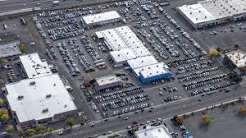
The cars that move are the ones nobody was driving. Dealer lots hold hundreds of vehicles parked in the open, in tight rows, with no cover at all. A storm that passes over an auto mall can damage an entire quarter’s worth of inventory in a single pass. Rental fleets, fresh-off-the-truck deliveries staged at ports and rail yards, and lease-return lots have the same exposure. These are concentrated, uninsured-by-the-driver, unsold vehicles sitting in one place — and that concentration is the source of nearly every storm car you will ever see listed.
This is why storm inventory is lumpy. It does not accumulate. One weather event drops a few hundred nearly identical, nearly new vehicles into the market at once, all with the same story.
Week one: the insurance decision
Once the storm passes, an adjuster walks the lot. Every vehicle gets an estimate, and every estimate gets compared against the car’s value. This comparison is the single most important event in a storm car’s life, because it determines everything that follows.
If the estimated repair is below the insurer’s threshold — usually a percentage of the actual cash value, which varies by state and carrier — the vehicle is repaired and sold normally. You will never know it was in a storm. If the estimate exceeds that threshold, the insurer declares a total loss, pays out the claim, and takes ownership of the car.
Here is the part that surprises people: the threshold has nothing to do with whether the car runs. It is arithmetic. A twelve-year-old sedan worth four thousand dollars, with three thousand dollars in dent work, is a total loss. A brand-new pickup worth sixty thousand, with three thousand dollars in dent work, is a quick repair. Same damage, opposite outcomes. The economics of hail damage cars for sale are shaped by this one calculation more than by anything mechanical.
Week two: the title changes
When an insurer totals a vehicle, the title changes to reflect it. Depending on the state, the brand might read salvage, hail, storm damage, or something similar, and the specific wording matters enormously for what you can do with the car afterward.
Some states have a dedicated hail brand that indicates only cosmetic damage. That brand is honest and useful: it tells a future buyer the car was totaled for dents, not for a wreck. Other states dump hail vehicles into the generic salvage category alongside collision and flood cars. On paper, those vehicles look identical to a car that hit a bridge abutment. They are not, but the title does not know that.
This branding lottery creates real price differences for identical vehicles. A truck totaled for hail in a state with a specific hail brand carries a cleaner story than the same truck totaled in a state that only issues generic salvage titles. When you are comparing hail cars for sale across state lines, read the exact title language rather than the listing headline.
Week three: the car goes to auction
The insurer now owns a few hundred dented vehicles and has no interest in owning them. Insurance companies are not car dealers. They want the asset converted to cash, quickly, with minimal handling. So the cars go to auction.
This step is not a fire sale by accident. It is the standard, deliberate disposal channel for every total loss in the country, which is why hail-damage auction cars exist as a category at all. The insurer has already paid the claim and made the vehicle whole for its owner. Whatever the auction returns is pure recovery. A higher price is nice, but the insurer’s incentive is speed and certainty, not squeezing the last dollar out of each unit.
That incentive is the buyer’s advantage. You are not negotiating against someone who loves the car or needs a specific number. You are bidding on an asset that its owner is actively trying to convert to cash.
The supply wave
Because storm cars arrive in batches, the market for them is cyclical in a way that most used-vehicle segments are not.
Six to twelve weeks after a major storm, a wave of nearly identical vehicles hits the listings from the same region. Same model year range. Same trim levels. Same dent pattern. Two hundred crossovers from one dealer group, or a full row of hail-damaged trucks for sale that were staged at a rail yard when the storm came through. The auction absorbs all of them at once.
Supply spikes hard, demand does not, and prices soften across the whole batch. If you are shopping deliberately, this is the moment you have been waiting for. If you shop in a quiet month, you are competing for the leftovers of a wave that broke six weeks ago.
What survives the pipeline intact
Trace a vehicle through the whole process and count what actually happened to it: it sat still while ice fell on it, an adjuster wrote an estimate, a title clerk changed a database field, and a transport truck moved it to a lot. That is the complete list of events.
Nobody drove it into anything. Nobody submerged it. It did not overheat, spin a bearing, or sit for a decade with a leaking head gasket. The mechanical condition on the day it reaches the auction block is the mechanical condition it had the day before the storm — which, for a dealer-lot car, often means delivery-mileage new.
That gap between the paperwork and the reality is the whole opportunity. The title says total loss. The odometer says four hundred miles. Both are true.
Where the pipeline can hide problems
None of this means every storm car is a clean bet, and the pipeline itself introduces two risks worth naming.
The first is exposure time. A car with a broken windshield or a shattered sunroof sits outdoors from the moment the storm hits until the moment it is loaded onto a transport truck. That can be weeks. Rain, sun, and standing water in the footwells during that window cause damage the storm itself did not. Broken glass plus a long stay on an open lot is the combination to watch for.
The second is stacked history. A vehicle can be hit by hail on top of an existing collision repair or an earlier claim. The hail brand is the loudest thing on the title, and it can distract from an older, more serious event underneath. Pull the history rather than reading the headline.
Shopping the pipeline instead of the listing
Once you can see the whole path, the strategy writes itself. Track major storms in Texas, Colorado, Nebraska, and the rest of the corridor, then start watching listings from those regions a month or two later. Prefer vehicles from dealer or fleet lots, where the storm is the only event in the car’s life. Read the title brand carefully and know which states use a hail-specific one. Prioritize intact glass. Bid into the wave, not into the quiet.
The cars are not cheap because something is wrong with them. They are cheap because an insurance formula, a title clerk, and a supply spike all landed on the same vehicle in the same eight weeks — and none of those three things left a mark under the hood.

