There is a specific moment in most businesses when spreadsheets stop working. Leads fall through the cracks. The sales team doesn’t know what the support team already told the customer. Marketing sends campaigns to people who already bought. Everyone is busy but nothing is coordinated.
This is not a people problem. It is a systems problem. And AI agents integrated into modern customer relationship management software are increasingly what businesses are using to solve it — automating the coordination work that used to fall on individuals and creating a single source of truth for every customer interaction.
According to statistics compiled by Blondish, customer relationship management software can increase sales productivity by up to 34% by 2026. The reason is straightforward: when every team member has access to the same customer information, in real time, decisions get faster and outcomes improve.
What Customer Relationship Management Software Actually Does
The term gets used loosely. CRM database, CRM platform, CRM solution — they all refer to the same core concept: a centralized system for managing every interaction a business has with its customers.
According to Zendesk, customer relationship management software is a unified set of sales, support, and marketing automation tools that allows companies to manage customer relationships from a single platform. The practical translation: instead of information living in someone’s inbox, a spreadsheet, or a team member’s memory, it lives in a system that anyone authorized can access, update, and act on.
The difference from traditional customer management methods is structural. Manual systems depend on individuals. When someone leaves, the information goes with them. Customer relationship management software makes knowledge institutional — it belongs to the organization, not the person.
Grand View Research reports that approximately 82% of companies were using customer relationship management software by 2025. That figure reflects how quickly it has moved from competitive advantage to basic infrastructure.
The Problems It Solves
When the team grows faster than the system
Most businesses hit the same wall at a certain size. Adding people doesn’t fix the coordination problem — it amplifies it. More team members means more places for information to get lost, more handoffs that don’t happen cleanly, and more customers who fall through the gaps between departments.
Customer relationship management software addresses this by making the system — not the individual — responsible for continuity. Every interaction is logged, every next step is tracked, and every team member picks up exactly where the last one left off. Growth stops creating chaos and starts creating capacity.
When reporting takes longer than the work itself
Without a centralized system, understanding what’s actually happening in the business requires pulling data from multiple sources, reconciling inconsistencies, and hoping nothing was missed. Customer relationship management software makes this automatic. Pipeline status, conversion rates, response times, and team performance are all visible in real time without anyone having to compile them manually.
When departments stop talking to each other
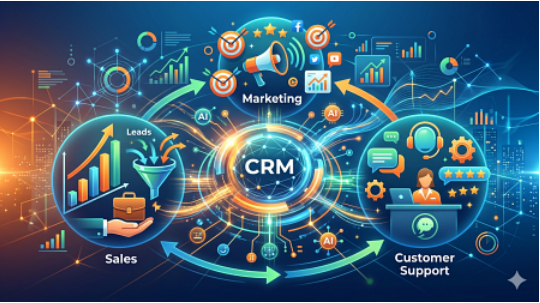
Sales, marketing, and support teams frequently operate with different information about the same customer. A lead generated by marketing arrives in sales without context. A support issue gets resolved but never makes it back to the account manager. Customer relationship management software creates a shared layer that connects these teams. When integrated with AI agent tools, it goes further — automating the handoffs between departments and ensuring every customer interaction is informed by full context.
Customer Relationship Management Software Tools Worth Knowing
Different businesses have different needs, which is why no single solution is right for everyone. Based on Monday’s compilation of the most successful tools:
- HubSpot is the most widely adopted option for businesses at any growth stage. Its pipeline management, lead tracking, and marketing automation sit inside a user-friendly interface that most teams can adopt without extensive training.
- Sugar CRM is built for B2B companies that need structured sales efficiency. Automated segmentation and sales process management are its core strengths.
- Salesforce handles complex sales environments with advanced customization. It is particularly strong for organizations where the buying process is long and involves multiple stakeholders.
Customer Relationship Management Software for Customer Support
The sales function gets most of the attention, but customer relationship management software is equally important for support operations. Based on Appvizer’s analysis of the best support-focused tools:
- Zoho CRM specializes in lead management and workflow automation, with strong capabilities for handling unexpected situations that generic bots can’t manage.
- Cirrus Shield delivers fast response times alongside personalized assistance across automated processes — useful for teams that need both speed and quality.
- Blue Note Systems CRM focuses on omnichannel support, managing lead generation and conversational processes through specialized integrations across multiple platforms.
Where AI Changes the Equation
Standard customer relationship management software collects and organizes data. When AI is layered on top, it goes further: analyzing patterns, predicting what a customer is likely to do next, and determining the appropriate action without waiting for a human to review the information.
In practice, this means a system that can identify when a lead is close to making a decision and trigger the right outreach automatically. Or one that routes support tickets based on complexity and urgency rather than a fixed queue. Or one that flags at-risk customers before they churn, giving the team time to intervene.
BCG research shows that approximately 30% of companies using customer relationship management software reach their initial objectives. When AI agents or automation tools are integrated, that figure rises to 80%. According to Salesmate, the average return on investment is $8.71 for every dollar spent — one of the clearest indicators of why adoption continues to accelerate.
Getting the Integration Right
Customer relationship management software does not deliver value in isolation. Its impact depends on how well it connects with the rest of the business. Three things matter most:
- Connecting sales, marketing, and support: For customer relationship management software to function as intended, these three areas need to share data and workflows. A marketing campaign that doesn’t feed into the sales pipeline, or a support log that sales never sees, creates the same fragmentation the software was supposed to eliminate.
- Data synchronization across platforms: Every platform the business uses needs to stay in sync. Inconsistent or outdated data leads to inconsistent decisions — which is a more dangerous problem than having no system at all.
- Building a unified customer view: Before any automation is applied, the foundation needs to be solid. A complete, accurate, and accessible view of each customer is what makes every downstream action more effective.
Wave Connect statistics show that 55% of customer relationship management software projects fail primarily due to lack of technical experience or clear knowledge about integration. Getting these three elements right before going live reduces that risk significantly.
The Bottom Line
Customer relationship management software has become the operational backbone of every competitive business in 2026 — not because it is trendy, but because the coordination problems it solves get more expensive as companies grow.
The businesses seeing the strongest results are not necessarily using the most expensive tools. They are using the right customer relationship management software, integrated properly, with clear objectives defined before implementation begins. That combination turns it from a contact database into a genuine growth engine.

