Introduction
Engineers and procurement managers sourcing critical sheet metal bending services often face a frustrating paradox: samples pass inspection, yet mass production delivers inconsistent angles, micro-cracks, or assembly fit failures. These issues cascade into project delays, rework costs, and strained supplier relationships.
The root cause is a supplier evaluation process fixated on unit price, while ignoring the engineering competencies that determine long-term quality stability and Total Cost of Ownership. Critical capabilities like springback compensation algorithms and material anisotropy management remain unevaluated. This article dissects five often-overlooked engineering criteria, providing a systematic framework to evaluate metal bending suppliers beyond price. Grounded in manufacturing engineering principles, these criteria empower readers to identify partners capable of guaranteeing precision, repeatability, and cost-effectiveness.
What Are the Foundational Engineering Principles Behind Precision Bending?
Understanding the physics of metal bending is essential for evaluating a supplier’s technical capability. The core challenge is springback — the elastic recovery of material after the bending force is removed. This phenomenon causes the final bend angle to be larger than the angle to which the tool formed it. Mastering springback prediction and compensation is the defining characteristic of a precision sheet metal bending expert.
- The Physics of Springback and Its Impact on Accuracy: Springback occurs because every material has a finite modulus of elasticity. When the punch retracts, the material relaxes, and the angle opens slightly. The magnitude of springback is influenced by material yield strength, thickness tolerance, and grain direction. A high-strength steel will spring back significantly more than a soft aluminum. A supplier that does not systematically account for these variables will struggle to achieve consistent ±0.1mm precision across different batches and materials.
- Key Variables Influencing Forming Quality: Beyond springback, several interrelated variables determine final part quality. Material thickness variation directly affects the neutral axis position and the force required. Rolling direction influences bendability; bending parallel to the grain can cause cracking on tight radii. The die opening width and punch radius also dictate the minimum achievable bend radius and the stress concentration at the bend line. A competent supplier controls these variables through process design and material verification.
- The Role of Standards in Establishing a Common Language: Clear communication of requirements is fundamental. Adhering to authoritative standards like ASME Y14.5 for geometric dimensioning and tolerancing ensures that design intent is unambiguous. Understanding the geometric relationships of tolerances, as outlined in resources from MIT OpenCourseWare, is fundamental to predicting manufacturing outcomes. This shared language allows engineers and suppliers to agree on what constitutes an acceptable part, eliminating ambiguity and reducing the risk of costly misunderstandings.
How to Assess a Supplier’s Capability in Predicting and Compensating for Springback?
The single most critical technical competency in precision bending is the ability to predict and compensate for springback with mathematical precision rather than guesswork. This capability separates advanced manufacturers from basic job shops. Evaluating this requires looking beyond equipment lists to the supplier’s engineering software and closed-loop control systems.
1. Offline Programming and Material-Specific Algorithms
Top-tier suppliers use offline programming software (e.g., Autoform, Deform) that incorporates material-specific algorithms to calculate predicted springback values before the first bend is made. These algorithms are calibrated using empirical data from thousands of previous bends across different material grades and thicknesses. The software generates a compensation value that pre-distorts the bend angle, so the part springs back to exactly the intended angle. This eliminates reliance on operator trial-and-error.
2. Real-Time Laser Angle Detection for Closed-Loop Correction
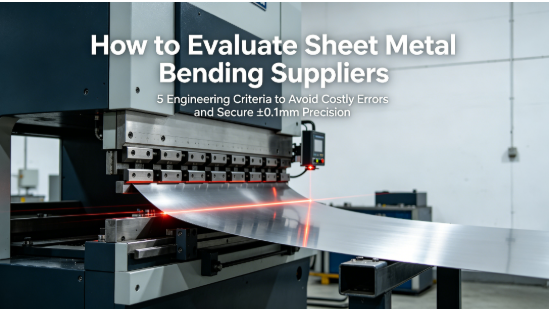
The most advanced systems integrate real-time laser angle detection into the press brake. A laser scanner measures the actual bend angle during the forming process, feeding data back to the machine controller. If the angle deviates from the target, the controller dynamically adjusts the punch penetration depth to compensate. This closed-loop correction achieves angular accuracy within ±0.1° for high-strength materials, compared to an industry average of ±0.5°. This is the difference between parts that fit and parts that fight.
3. Data-Driven Verification of Capability
When evaluating a supplier, ask for evidence of springback compensation performance. Request data showing the achieved angular accuracy for a material similar to yours. A capable supplier will be able to demonstrate a Cpk value for their bending process, proving statistical control. For a deeper understanding of how to translate these engineering criteria into a practical supplier audit, a detailed industry guide on five proven sheet metal bending quotes provides a structured evaluation framework.
Why is Control of Cumulative Tolerances and Tooling Interference a Decisive Factor?
For parts requiring multiple sequential bends, the risk of cumulative tolerance stack-up and tooling interference grows exponentially. Each bend introduces a small positional error; over six or eight bends, these errors can sum to a total deviation that makes the part unusable. The supplier’s ability to manage this accumulation is a decisive factor for complex assemblies.
1. The Challenge of Multi-Bend Accumulation
In a traditional setup, each bend relies on the previous one as a reference. If the first bend is off by 0.1mm, that error propagates through every subsequent bend. For a bracket with ten bends, the final feature could be misplaced by over 1mm. This tolerance stack-up is a primary cause of assembly failures. Overcoming it requires both advanced fixturing and intelligent process sequencing.
2. Six-Axis CNC Backgauges and 3D Simulation
Advanced press brakes are equipped with six-axis CNC backgauges that precisely position the sheet metal for each bend, independent of previous bends. This eliminates the propagation of error. Furthermore, 3D bending simulation software visualizes the entire sequence digitally, detecting potential collisions between the workpiece, tooling, and machine frame before production begins. This allows engineers to optimize the bend order and select the correct tooling, preventing scrap and rework.
3. The Role of Standards in Managing Complexity
For components involving complex geometries, adherence to authoritative standards is essential. The ASME Y14.5 dimensioning and tolerancing standard provides a framework for defining and controlling the geometric relationships between features, ensuring interchangeability and functional performance. A supplier that applies this standard in their process planning demonstrates a commitment to precision manufacturing and systematic quality.
What Differentiates True “Zero-Indentation” Bending for Aesthetic Parts?
For visible components in consumer electronics, medical devices, and automotive interiors, surface perfection is a non-negotiable requirement. Traditional steel dies can leave visible marks, scratches, or indentations on aluminum and stainless steel, requiring costly secondary polishing. True “zero-indentation” bending is a specialized capability that eliminates this problem at the source.
1. The Root Cause of Surface Damage
Surface damage occurs from hard contact between the metal die and the workpiece. The high pressure required to form the bend can cause the die’s surface texture to imprint onto the part. Sharp edges on the die can scratch the material. Even microscopic debris trapped between the die and sheet can create a dent. Preventing this requires a fundamental change in the tooling interface.
2. Technologies for Zero-Indentation Bending
Several techniques achieve zero-indentation results. Polyurethane dies deform elastically under pressure, conforming to the sheet metal without marking it. Protective films applied to the sheet before bending act as a sacrificial barrier. Polished chrome-plated dies with controlled surface roughness minimize friction. The most effective approach combines these methods with precise tonnage control to avoid over-compression. A well-implemented zero-indentation process can maintain a surface finish of Ra < 0.8 µm, eliminating the need for post-bend polishing.
3. The Cost and Time Savings of Eliminating Secondary Operations
The value of zero-indentation bending extends beyond aesthetics. By eliminating secondary polishing, the total manufacturing time and cost are significantly reduced. Parts can move directly from the press brake to assembly or surface finishing (e.g., powder coating). This capability is a hallmark of a precision metal bending service that understands the total cost of production, not just the bending operation itself.
How to Verify Quality Control Systems That Ensure Mass Production Stability?
A supplier’s quality control system is the institutional framework that guarantees mass production stability. It is not enough to inspect quality into a part at the end of the line; the process itself must be controlled to prevent defects. Evaluating this system requires examining their use of Statistical Process Control (SPC) , process capability indices, and traceability protocols.
- The Significance of Cpk Value for Critical Processes: The Process Capability Index (Cpk) is a statistical measure of how well a process can produce output within specification limits. A Cpk of 1.33 or higher is the industry benchmark for a capable process, corresponding to a defect rate of approximately 63 parts per million. When evaluating a supplier, ask for the Cpk value for their critical bending operations. A value below 1.33 indicates a process that is not stable enough for high-volume, high-precision work.
- SPC Charts and Real-Time Monitoring: Beyond a single Cpk number, a mature quality system uses Statistical Process Control (SPC) charts to monitor key parameters in real-time. These charts track the running average and range of a critical dimension (e.g., a bend angle) over time. If the data shows a trend toward a control limit, the operator can intervene before any parts are produced out of spec. This preventive approach is far more effective than final inspection.
- The Importance of First Article Inspection and Traceability: A comprehensive First Article Inspection (FAIR) report is the foundation of quality assurance for any new part. This report should include dimensional data for every critical feature, verified against the drawing using calibrated CMM or optical measurement equipment. Furthermore, material traceability ensures that every finished part can be linked back to its raw material batch. Suppliers certified to ISO 9001, IATF 16949, or AS9100D have proven systems for managing these requirements. Selecting a partner with verifiable engineering capability and robust quality systems is the ultimate safeguard for obtaining stable metal bending services.
Can Early Design Feedback (DFM) from Suppliers Actually Reduce Costs?
Design for Manufacturability (DFM) is the practice of designing a part to be easy and cost-effective to manufacture. While often discussed, its practical application in sheet metal bending can yield dramatic, quantifiable savings. Early supplier involvement in DFM is not just a courtesy; it is a cost-reduction strategy that prevents problems before they require expensive tooling changes or scrapped parts.
1. Common Design Traps Identified by DFM
Inexperienced designers often create features that are difficult or impossible to bend consistently. A common example is placing a hole too close to a bend edge. The stretching and compression of the metal during bending can distort the hole, or the hole can act as a stress concentrator, causing cracking. A DFM review will identify this and recommend a minimum safe distance. Other traps include specifying an unrealistically tight bend radius for the material thickness or ignoring grain direction for high-strength materials.
2. Quantifying the Savings from DFM Intervention
The savings from DFM are real and measurable. In one documented case, a supplier’s DFM review identified that a customer’s part had a hole located only 4mm from the bend line, causing an 18% scrap rate. By moving the hole to 8mm and adjusting the bend radius, the scrap rate dropped to 3%, saving the customer nearly $100,000 annually. This is a clear example of how engineering input during the design phase pays for itself many times over.
3. DFM as a Core Supplier Selection Criterion
When evaluating potential partners, assess their willingness and ability to provide proactive DFM feedback. A supplier that simply accepts a print and quotes a price is a vendor. A supplier that reviews the design, identifies potential issues, and suggests improvements is a partner. This collaborative approach is a hallmark of mature B2B manufacturing sourcing relationships and is a strong indicator of long-term value creation.
Conclusion
Evaluating sheet metal bending suppliers is a strategic decision that extends far beyond comparing unit prices. A systematic assessment must probe the supplier’s engineering methodology for springback compensation, their control of cumulative tolerances, their capability for zero-indentation finishing, the robustness of their quality system, and their willingness to collaborate on DFM. These five engineering criteria form a powerful framework for identifying partners capable of delivering consistent ±0.1mm precision and long-term value, rather than just a low initial quote. Investing in this evaluation process is the most effective way to de-risk your supply chain and ensure the success of your critical projects.
FAQs
Q: What is the most commonly overlooked factor when evaluating sheet metal bending suppliers?
A: The most overlooked factor is the supplier’s engineering methodology for springback compensation. Advanced suppliers use offline programming with material-specific algorithms and real-time laser angle measurement for closed-loop correction. Many still rely on operator experience, leading to inconsistency in mass production.
Q: How can I prevent surface scratches or indentations on the bend lines of visible aluminum or stainless-steel parts?
A: Preventing surface damage requires a dedicated “zero-indentation” bending process using specialized tooling like polyurethane dies or protective films. Tonnage must be precisely controlled. Request samples of bent aesthetic parts to verify this capability before ordering.
Q: What questions should I ask to assess a supplier’s quality control for high-volume production?
A: Focus on process control. Ask: “What is the Cpk value for your critical bending processes?” (aim for ≥1.33). “Do you use SPC charts to monitor parameters in real-time?” “Can you provide a complete FAI report?” These answers reveal if their system prevents defects proactively.
Q: My design has multiple close-tolerance bends. How can I ensure the parts won’t have tooling interference or cumulative tolerance issues?
A: Suppliers should use 3D simulation software to visualize the bending sequence and check for collisions. Six-axis CNC backgauges allow precise repositioning between bends, minimizing error accumulation. Always ask if they perform offline programming and simulation for complex parts.
Q: Why is early supplier involvement in DFM so important for sheet metal bending projects?
A: Early DFM involvement identifies issues like holes too close to bend edges or unrealistic radii before tooling is cut. This collaborative approach simplifies the part, reduces scrap rates, and eliminates secondary operations, lowering total cost and lead time far beyond a unit price reduction.
Author Bio
The insights in this article are drawn from over fifteen years of engineering experience in precision manufacturing. The perspective is informed by the practices of an advanced manufacturing partner holding certifications including ISO 9001, IATF 16949, AS9100D, and ISO 14001. For teams seeking to apply these engineering criteria to their next sourcing decision, a detailed supplier evaluation checklist and personalized sheet metal bending quotes are available through the company’s resource page. The team at LS Manufacturing specializes in transforming complex design challenges into reliable, cost-effective production outcomes through rigorous engineering and quality systems.

